
How to begin a career in HR: from people skills to professional qualification (and why liking people is not enough)
Human Resources
How to begin a career in HR? Skills & qualifications | GBS
Posted 16 August
Most articles about starting a career in Human Resources open the same way: if you are a people person, HR could be for you.
It is a comfortable idea, and it is highly misleading.
Being good with people is not the job. In fact, on its own, it may not even help. HR is one of the most procedural, legally grounded functions in any organisation. The people you will admire in the profession are not simply warm. They are precise. They know employment law, they follow process faultlessly, they document everything, they know exactly what can and cannot be said in a difficult conversation, and they do all of it while remaining calm, courteous and composed under pressure.
That combination - procedural rigour delivered with genuine professionalism and warmth - is a skill set, not a personality type. It has to be learned. That is the honest reason a qualification matters, and it is the premise of this article.
If you are considering a career in HR, changing direction professionally, or wondering whether your communication and organisational skills could become something more, the following will give you a clear-eyed picture of what the profession actually involves and how to prepare for it.
Turning people skills into a career path
Let us be clear about what HR is.
HR is a function of the organisation, and it works on behalf of the organisation. Its job is to make sure the people the organisation employs are recruited, managed, developed and, where necessary, exited lawfully, fairly and effectively.
That includes protecting the organisation's legal interests, ensuring contractual obligations are met on both sides, and making sure the organisation meets its social, moral and legal responsibilities to its people.
This is not a criticism of the profession. It is the profession.
And understanding it early is what separates people who thrive in HR from people who arrive expecting something else. The role asks you to hold a genuinely demanding position: representing an organisation while treating its people with fairness and respect, and doing both without pretending there is no tension between the two.
So where do people skills fit in?
They are the delivery mechanism - you need them by the buckload. In fact, your interpersonal communication will really help immensely, because there is something of a tightrope to be walked between having a genuine compassion for your fellow humans on the one hand (why not, after all, that’s a good thing), and being able to share news and have difficult conversations which are addressed more at the role that same person is playing within the organisation you’re paid to represent.
But let’s not get ahead of ourselves here.
Your starting point may be that you may already have transferable foundations from customer service, administration, team leadership, hospitality, business support, education or operations. That may have led you to handle sensitive conversations, manage differing expectations, and keep cool in difficult situations, and maybe even work with documentation and process.
The career step that will see you begin a career in HR is about learning to apply those within the formal, legal and procedural framework that HR actually operates in.
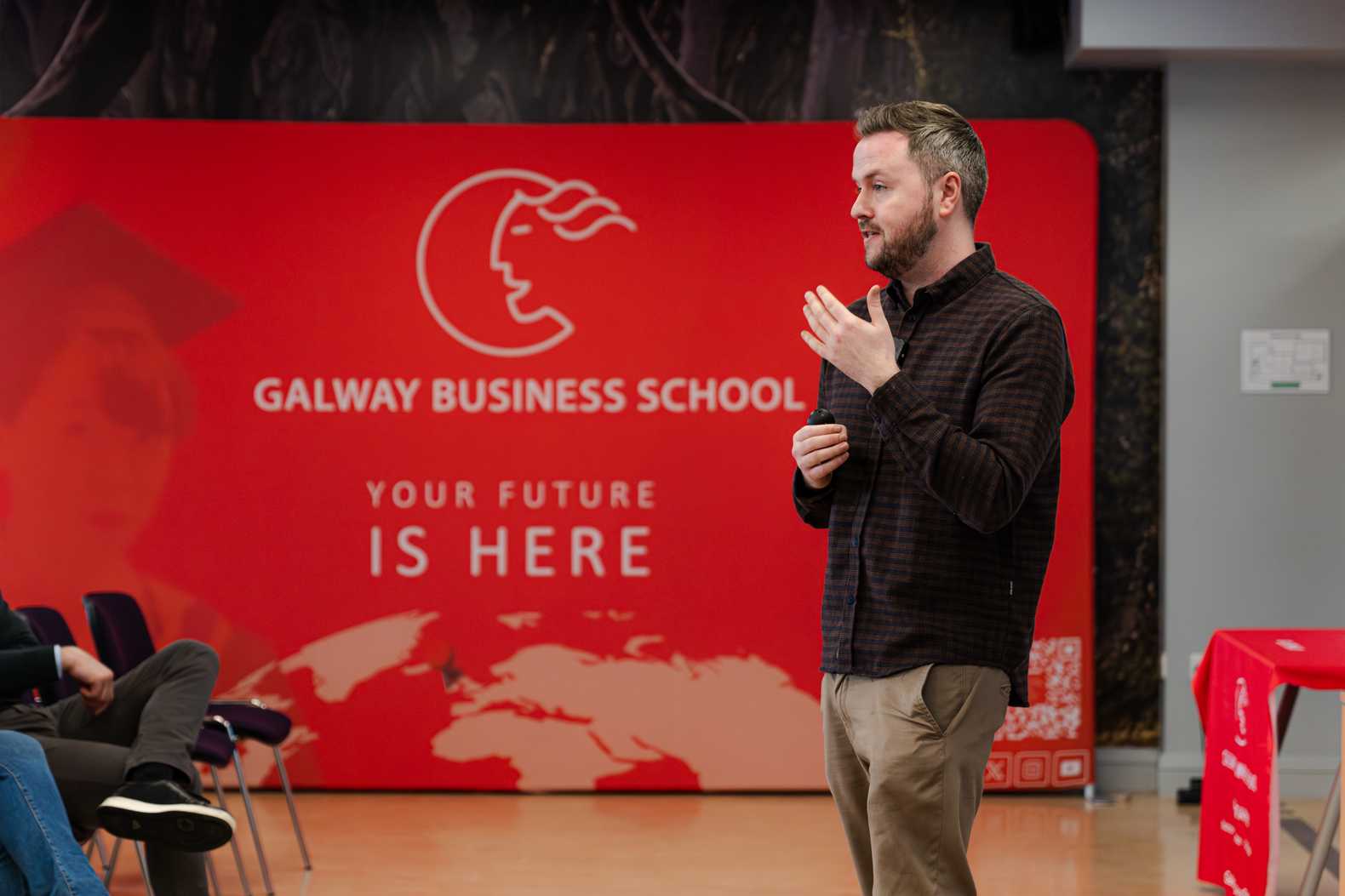
Industry Week @Galway Business School
What does a career in HR involve?
A career in HR can include a wide range of responsibilities depending on the organisation, the size of the team and the level of the role.
In smaller businesses, HR professionals may work across several areas at once.
In larger organisations, they may specialise in recruitment, employee relations, learning and development, payroll, compliance or people operations.
In big multinational structures, we get into HR partnering, where you may carry out the HR function but almost seconded to a function of the organisation, like marketing, or research and development.
Common areas of HR work include:
- Recruitment and selection
- Employee onboarding
- Contracts, documentation and HR administration
- Workplace policies and procedures
- Employment law and compliance
- Employee relations, grievances and disciplinary processes
- Performance management
- Training and development
- Workplace culture and communication
- Staff well-being and engagement
Look at that list honestly and one thing stands out: most of it is about creating, following, reviewing and improving the procedures and processes and policies everyone adheres to.
A large part of HR is doing things correctly, in the right order, with the right documentation, because getting the process right is both how organisations treat people fairly and how they protect themselves legally.
If you are exploring human resources courses in Ireland, this is worth knowing early!
If you are someone who likes structure, accuracy, detailed rules and clear process, that is not a limitation in HR. It is a core competency.
The role of Human Resources in today's workplace
Human Resources has changed significantly over the years.
Once seen mainly as an administrative function, HR now plays a much broader role in how organisations attract, support and retain people, and in how they respond to employment legislation, hybrid work, diversity and inclusion, wellbeing, skills development and organisational change.
That broader role brings a real tension, and honest HR professionals acknowledge it rather than deny it. HR must understand employees and support them, while ultimately representing the responsibilities and interests of the employer. Managing that dual position with integrity - being straight with people about what HR can and cannot do for them - is one of the defining skills of
the profession, and one of the hardest.
When you’re considering a qualification in HR, this is part of what makes HR a substantial area to study.
It brings together law, business, psychology, ethics, communication and management, and asks you to apply all of them, sometimes under a fair amount of pressure, with real consequences for real people.
Authoritative resources such as CIPD Ireland and the Workplace Relations Commission are useful starting points for understanding professional standards, employment rights and workplace best practice in Ireland.
Key skills that can help you succeed in Human Resources
People skills matter in HR, but on their own they are not enough, and warmth without discipline can actually be a liability in this role. The profession rewards a specific combination: rigour in how you handle processes, and professionalism in how you handle people.
Procedural discipline
Much of HR is following defined processes precisely: recruitment stages , grievance procedures, disciplinary steps, notice periods, documentation. Getting it right and managing people carefully reduces risk to the company. Cutting corners and getting it wrong increases risk.
Working knowledge of employment law
HR professionals do not need to be lawyers, but the work has a genuinely paralegal dimension. You need to know what the law requires, where the boundaries sit, what must be documented, and when to escalate to specialist advice.
Communication, including knowing what not to say
HR professionals act as a bridge between employees, managers and leadership.
Clear communication is not just about being articulate. It is about saying the right things: knowing what can be said, what cannot, and how to deliver difficult messages properly and lawfully, which helps everyone.
Composure under pressure
HR work can involve emotionally charged situations: conflicts, complaints, dismissals and personal difficulties.
The professional standard is to remain calm, courteous and fair regardless of what is happening in the room. There is a performance element to this, and like any performance skill, it can be trained for. Getting it right is often a real source of job satisfaction.
Confidentiality and discretion
HR handles sensitive information as a matter of routine. Knowing how to hold information appropriately (and understanding your obligations around it) is fundamental.
Fairness and consistency
Empathy matters, but in HR it must operate within consistency. Treating similar cases in similar ways is what makes a workplace fair, and it is what stands up to scrutiny afterwards.
Business awareness
HR decisions happen inside a business context. Understanding organisational goals, structures and constraints helps HR professionals give advice that is both fair and realistic.
These skills can develop through experience, but the technical and legal core cannot be picked up by instinct. For many students, a structured HR qualification is what connects natural interpersonal strengths with the knowledge the role actually requires.
Galway Business School Indusrty Week
Building confidence through HR knowledge
If HR really were just about being good with people, a qualification would be optional. Because HR is substantially about law, procedure and professional judgement, study is what makes the difference.
A good introduction to HR covers recruitment, employee relations, workplace policies, employment legislation, performance management and learning and development. More importantly, it teaches you why the processes exist, what they protect, and what goes wrong when they are not followed.
Consider the situations an HR professional may face early in their career:
- supporting a recruitment process that must be demonstrably fair
- responding to a workplace conflict where both parties have legitimate concerns
- helping a manager follow the correct internal procedure when performance is a problem.
Good instincts do not resolve these. Knowledge, structure and professional judgement do.
For learners considering a human resource management certificate, this is often the most valuable outcome: understanding the HR function as it really operates, and feeling genuinely prepared to work within it rather than surprised by it.
You can also explore GBS's existing article on whether getting a professional certification in Human Resources Management is worth it for more guidance on the value of professional HR study.
The value of professional HR study
Read MoreWhat can you study to move into HR? Choosing the right study path for your goals
Some people begin in administrative roles and gradually move into HR. Others enter after studying business, management, psychology or a related area. Some choose HR after years in another sector because they want work that combines people, process and organisational responsibility.
When researching human resource management courses in Ireland, think about your current experience and your goals.
If you are new to HR, you may want a course that introduces the foundations of Human Resource Management, including its legal and procedural core, in a clear and practical way.
If you are already working in business or administration, you may want a qualification that supports a move into a more specialised HR role. If you are balancing work, study or family commitments, flexibility may also matter.
A short certificate course can be a good option for students who want focused, practical knowledge without committing to a long-term programme straight away.
Galway Business School offers a Human Resource Management short certificate course designed to introduce learners to the key areas of HRM and support their professional development.
Students exploring broader professional development options can also view GBS's full range of short certificate courses.
This type of study can be especially useful for people searching for HR management courses Ireland, human resources courses Ireland or a human resource management certificate that supports their next career step.
Taking your first steps into the HR profession
Once you have started building your knowledge, the practical question is how to get in. The honest answer is that most HR careers begin in support roles, and that is not a consolation prize. It is where you learn the machinery of the profession.
Entry routes worth considering include:
- Applying for HR Assistant
- HR Administrator, or
- Recruitment Coordinator roles
Moving sideways within your current organisation
If you already work in administration, operations or customer-facing roles, an internal move into an HR support role is one of the most common and realistic routes in, especially if you can point to a qualification underway.
Taking on HR-adjacent responsibilities where you are: onboarding new starters, coordinating training, maintaining records, supporting recruitment. These give you honest, concrete examples for applications and interviews.
When you apply, position yourself accurately
Rather than presenting yourself as a people person, present evidence of the things HR actually runs on: accuracy with documentation, discretion with sensitive information, calm handling of difficult situations, and a working understanding of process.
Paired with formal study, that is a far more credible pitch to an HR manager than enthusiasm alone, because it shows you understand what the job is.
And treat your own job search as early practice. Reading job specifications closely, following application processes precisely and communicating professionally throughout are, in miniature, the exact skills the role demands.
Career opportunities in Human Resources
Human Resources can lead to a wide variety of career opportunities.
The exact path depends on your experience, qualifications, interests and the type of organisation you work in.
Possible HR-related roles include:
- HR Assistant
- HR Administrator
- Recruitment Coordinator
- Training and Development Assistant
- HR Officer
- Employee Relations Assistant
- People Operations Coordinator
- Learning and Development Coordinator
Some people enjoy the recruitment side of HR. Others are drawn to employee relations, training, compliance, HR operations or workplace culture. Over time, HR can also lead to more strategic roles in management, organisational development or people leadership, because HR professionals develop something genuinely valuable: a working understanding of how organisations function from the inside - legally, structurally and humanly.
Career progression takes time. A qualification helps you build foundations, but experience, continued learning and professional development are also part of the journey.
Further reading:
It is also worth spending time with trusted employment and workplace resources. Citizens Information provides clear information on employee rights and entitlements in Ireland, while Gov.ie offers guidance on working in Ireland.
Understanding employment from the employee's side is itself good preparation for HR: the best HR professionals know exactly what the people in front of them are entitled to.
You can also read GBS's guide to the Human Resources career path for more detail on how HR careers can develop over time
GBS's guide to the Human Resources career path
Read MoreTurning people skills into a professional path
A career in HR may begin with an interest in people, but it is built on knowledge, procedure and professional judgement.
If you enjoy communication and organisation, and you are also someone who values doing things correctly, consistently and by the book, Human Resources offers a meaningful professional direction.
It will ask more of you than being likeable. It will ask you to represent an organisation while treating its people fairly, to master rules and follow them faultlessly, and to stay composed when situations are difficult. Done well, it is skilled, responsible work that organisations genuinely depend on and for which you are deeply appreciated.
For students considering their next step, a structured qualification is the practical way to understand the profession as it really is, and to enter it with confidence rather than assumptions.
At Galway Business School, students are supported in developing the knowledge and practical understanding they need to take the next step towards their professional goals.
HR FAQs
Too long, didn’t read? Here are some bite-sized frequently asked questions on HR work and qualifications.
Does HR work for employees or for the employer?
HR works for the employer.
Its role is to help the organisation employ people lawfully, fairly and effectively, which includes protecting the organisation's legal interests. Good HR professionals are honest about this, and it does not stop them treating employees fairly: employment law, company policy and professional standards all set out responsibilities the organisation owes its people, and HR is accountable for making sure those are met. Understanding this position clearly is part of doing the job well.
How do I start a career in HR with no experience?
Start by identifying your transferable skills, such as communication, organisation, administration, customer service or team support. Entry-level roles such as HR Assistant, HR Administrator or Recruitment Coordinator can help you gain practical experience. Studying Human Resource Management will help you understand the procedures, legal responsibilities and processes the role involves, which is often what distinguishes candidates without direct HR experience.
What skills do you need for a career in HR?
Useful HR skills include procedural discipline, working knowledge of employment law, communication, confidentiality, composure under pressure, fairness, attention to detail and business awareness. HR professionals need to support people while working accurately within policies, procedures and legal requirements. Being a people person alone is not enough.
Is a human resource management qualification useful?
Yes. Because HR involves employment law, formal procedures and decisions with real consequences, structured knowledge matters more than in many people-facing roles. A qualification is especially helpful for people moving into HR from another area, returning to study, or looking to progress from a general business or administrative role.
Can I study HR online while working?
Many students choose flexible, online or part-time study options so they can continue working while developing their HR knowledge. This can be useful because it allows learners to connect what they study with real workplace situations as they encounter them.
What jobs can HR courses lead to?
HR courses can support progression towards roles such as HR Assistant, HR Administrator, Recruitment Coordinator, Training and Development Assistant, HR Officer or People Operations Coordinator. Career outcomes depend on your previous experience, qualification level and continued professional development.
Contact us with your questions - we’d love to help you choose the right course for your current skills and your future ambitions.
 00353 91 529000
 info@galwaybusinessschool.ie